

This article was updated on 11/21/2025.
Does Good Web Design Matter?
You have a few milliseconds to make the right first impression on your website.
There’s only one chance to make the right first impression—whether you’re dressing sharp for a job interview or meeting your significant other’s parents for the first time. Getting off on the right foot from the start is crucial—and it’s no different when it comes to your website.
In today's digital age, modern design is essential for making a strong first impression and establishing your business online.
According to research published by Taylor & Francis, visitors form an opinion of your website in about 0.05 seconds. That’s all the time you have to make a good first impression.
Good web design is the key to making that first impression count. You can either convert—or lose—visitors based on a design that fails to tell your story in a compelling way.
A website is likely the first thing new customers encounter. If your website’s design falls short, you might lose that potential customer to another business with all the right elements—contemporary design, professionally written copy, and good UX (User Experience). On an e-commerce site, first impressions formed quickly can significantly influence user trust and buying decisions.
Video: The Benefits of a Website Rebuild Instead of Redesign

A well-designed website isn’t just attractive—it builds trust, elevates your brand, improves usability, and increases conversions. From intuitive UX and fast load times to consistent branding and professional visual assets, every design decision shapes user perception.
The
A Quick Summary
- First impressions are design-driven, making modern, user-focused visuals essential for credibility.
- Clear, intuitive UX keeps users engaged and can significantly reduce bounce rates.
- Fast website speed directly increases conversions and improves overall user satisfaction.
- Consistent branding and professional-quality assets strengthen trust and recognition.
- A well-crafted, responsive site positions your business as a strong competitor—locally or globally.
Guide To Good Web Design
Statistics on Web Design First Impressions
First impressions are everything, especially in web design. Did you know that 94% of first impressions are design-related? This statistic alone underscores the importance of a well-crafted website design. When users land on your site, they immediately form an opinion about your brand based on its visual appeal and usability. Key aspects of web design, such as layout and visual hierarchy, play a crucial role in shaping these first impressions.
Moreover, 75% of users admit to making judgments about a company’s credibility based on its web design. This means that a poorly designed website can significantly harm your brand’s reputation and trustworthiness. On the flip side, a well-designed site can enhance brand recognition and foster trust.
Visual elements play a crucial role in this process. People following directions with text and illustrations do 323% better than those following directions without illustrations. This highlights the importance of incorporating visual aids into your website design to improve user comprehension and engagement.
Additionally, 65% of senior marketing executives believe visual assets are core to how their brand is communicated. Colors and visuals not only influence purchase decisions but also evoke emotions and enhance brand recognition. These visual assets are key elements in communicating your brand's identity, ensuring that your website consistently reflects your company's personality and values. Therefore, investing in high-quality visual assets is essential for creating a positive first impression and building a strong brand identity.

Branded Web Design
As a design agency with 15 years of experience, we know that strategy comes before visuals. Before drafting our first design concept, we take the time to understand your company’s goals and create a website architecture that aligns seamlessly with your brand. Bringing a professional web designer in at this early stage ensures that both your business objectives and user needs are fully addressed. No competent web agency should overlook this step—it’s about far more than aesthetics. It’s about building a website that strengthens your brand identity and communicates your message with clarity and impact.
We begin the design process by researching the brand’s personality. Is it serious, playful, or neutral? Understanding this helps shape the visual language, tone, and overall structure of the website, ensuring consistency across all touch points. Mapping out the user journey at this stage ensures visitors are guided intuitively through the site, leading them toward desired actions and conversions.
Beyond aesthetics, a well-designed website must serve its purpose effectively. We analyze your business requirements to determine what features your website needs and design them in a way that enhances user experience. Ensuring a responsive design is crucial, allowing your website to function seamlessly across all devices. This not only improves usability but also strengthens your brand recognition and experience across all devices.

Good Web Design Creates Trust
A well-designed website is more than just a pretty face; it’s a powerful tool for building trust and driving sales. In fact, 88% of online consumers are less likely to return to a website after a bad experience. This statistic highlights the importance of a positive first impression in website design. Don't let people bounce on to your competitors.
Website user testing is essential for understanding what works best for your business. You should gather feedback from real users, you can identify pain points and areas for improvement, ensuring that your website meets the needs and expectations of your target audience.
First impressions are crucial for website design, as they can make or break a user’s experience. A positive first impression can lead to higher user satisfaction and brand loyalty. A positive user experience is essential for building trust and encouraging repeat visits. When users have a seamless and enjoyable experience on your site, they are more likely to return and recommend your brand to others.
In summary, good web design is a key factor in creating trust and enhancing brand recognition. By prioritizing user experience and investing in high-quality design elements, you can make a lasting positive first impression and build a loyal customer base. Good web design also fosters customer engagement by making it easy for users quickly understand what you do.
Website Credibility is Built on Design
Research shows that around 75% of people judge an organisation’s credibility based largely on its website design. Think of it as the difference between turning up to a client meeting dressed to impress or showing up in your weekend sweats. You only get one shot at that first impression!
Much of the information we take in is visual. Our brains process images, layout, and color extremely quickly, which makes it far easier to scan a page than to read through blocks of text. Nobody wants to experience some that resembles a white paper. That’s a big reason so many first impressions are design-related with visuals that grab attention.
How fast do you size up a website just by looking at its visuals and headings? Pretty much instantly. That’s exactly why smart agencies rely on expert website copywriters to bring a brand to life. Strong headings, clear taglines, and well-written copy aren’t just words—they’re part of the visual experience.
Pair that with intuitive layout and navigation, and users can find what they need without thinking. That builds trust and keeps them engaged. And remember: visitors are always comparing your site to someone else’s. Standout design doesn’t just look good—it shapes perception and helps you win the click.
Bad Design Creates a Lack of Trust
The value of good web design reigns supreme. In one study, 94% of the reasons people gave for distrusting a website were related to its design. In other words, your website’s visual appeal can directly influence whether customers stay or bounce.
If that staggering statistic wasn’t enough to get your attention, consider what it means for your company: customers won’t put their faith in your business if your website isn’t easy on the eyes. That affects everything from clickthrough rates to revenue, as consumers become less likely to engage with brands they don’t trust. A slow website can further undermine trust and hinder business success by driving visitors away before they even see your content or hear your pitch.
Simply put, good design is no longer optional in a world that has endless choices—it’s essential to your business’s success.
Web Design and Brand Perception
Aesthetics greatly impact how potential customers perceive your brand. Nearly half of all consumers (46.1%) assess a site’s credibility based on its visual design elements, such as layout and typography.
For example, think about the preconceived brand expectations you have before you walk into a Ritz-Carlton or another premium hotel. You’re anticipating a luxury experience—from the moment you step through the doors to the comfort of a restful night’s sleep. While there are certainly more affordable hotels that offer excellent accommodations, the question becomes: how do you want to be perceived?
The same principle applies to your website. With the right team behind you, your site can deliver a “Ritz-level” experience—one that elevates your brand and leaves a lasting impression. And to be clear, this analogy isn’t about spending like the Ritz; it’s about creating an excellent experience with the right team that understands your goals and works within your budget.
Consider whether your website presents your business as a national competitor—or merely a local one. In today’s market, a strong digital presence is essential for standing out and building trust. We approach every project with the belief that our clients, regardless of size, should be positioned to compete on a global level. We aim for that “Ritz perception.” That’s why, if you don’t have the expertise in-house, it’s crucial to partner with a website design agency that truly understands the principles of effective, high-quality web design.
The Fix is in the Design
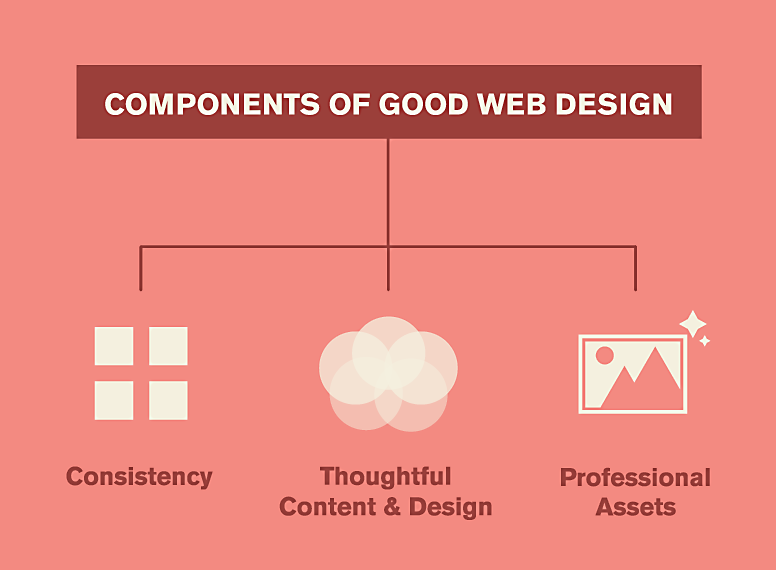
The solution is straightforward. Improving your website’s design and user experience is the most effective method of preventing users from leaving your site based on a snap judgment. Enhancing user experience is key to keeping visitors engaged and encouraging them to interact with your content. Good design includes professionally produced assets like photography, video, and animation, and it guides users toward your desired actions. The following are pillars of all sites with good web design.

Thoughtful Design and UX
Interestingly, a well-designed user interface can increase conversion rates by up to 200%. The example above is pretty basic but consider all the other menu items that will be placed in the menu. We see a lot of these simple to fix UX designs systems but they may not be glaringly obvious to the untrained eye.
Hicks Law isn't something that everyone knows about but it always in the back of my mind. Here's the shorthand: If you’ve heard of the phrase “K.I.S.S — Keep it Simple and Straightforward”, then you’ll already have a solid grasp of the underlying principle of what the Hick Hyman Law tries to achieve.
According to Hick’s Law, the more options you give someone, the longer it takes for them to make a decision. And when there are too many options? People freeze. That’s the classic “information overload” moment where users get overwhelmed and end up taking no action at all.
Thoughtful UX design solves this by stripping away the noise and focusing on what actually matters. It’s about understanding what users need, what they don’t, and creating a path that feels effortless—not exhausting. When you reduce unnecessary choices, you make it easier for people to move forward, engage, and convert.
UX design is the whole process of shaping and integrating an experience, including branding, design, usability, and functionality. Good UX is about anticipating user needs, understanding their motivations, and refining the site based on real user feedback. Search engines like Google favor websites that offer a good user experience and real-world answers to searchers inquiries.

There is no one-size-fits-all “golden rule” for good user experience; each design should be reviewed individually to make sure the layout and functionality align with the principles of good UX for your situation. Ultimately, a good UX design feels natural and enjoyable and anticipates a user's expectation.
Much like a beautifully designed retail space—think an Apple Store. Where every display, aisle, and lighting choice quietly guides you forward toward making a buying decision. They have everything on display so you go hands-on with much of their offerings so you can explore at your own pace. Checkout, no problem there is an associate floating around with a payment device and more information if you need it.
A great website should feel just as intuitive. You don’t have to think about where to go next. You just move naturally through the experience with a CTA or contact button strategically located and at the ready.
That kind of “invisible design” isn’t luck. It’s the result of intentional choices, years of refinement, and a team that understands how to shape a user journey so well that it feels effortless. Every interaction, every layout choice, every piece of copy works together to create the path of least resistance—so users always know exactly where to go and what to do next.

Website Speed
Speed—how fast your website pages load—is another critical factor in preventing people from bouncing off your site. Having your site load quickly, with optimal load speed, is crucial because visitors aren’t interested in waiting.
Prioritizing website speed is not merely a technical consideration but a strategic business imperative. By optimizing load times, you enhance user experience, build trust, and ultimately drive higher conversion rates. Put simply, if your website is faster than your competitors, you immediately have an edge over them. No one wants to see the spinning ball!
• A site that loads in one second converts about three times better than one that takes five seconds. (Source PORTENT, 2022)
• Nearly 70% of consumers say page speed impacts their purchasing decisions. (Source Search Engine Journal, 2019)
Consistency
The cliché “Consistency is key” exists because it’s true for good web design and every design field. Delivering a consistent user experience is pivotal for your website, visually and functionally. Consistency builds familiarity, and familiarity fosters trust.
No successful brand can thrive unless its design is consistent. Consistency in brand identity is one of the most important pillars of recognition. It's no secret that consistency is a best practice in everything from visual design to user experience. However, it is frequently overlooked. Every piece of your brand's design aesthetic should appear cohesive. Each item complements the other, resulting in information that is balanced and easy to comprehend. Consistency helps your brand stand out in a crowded marketplace and creates lasting impressions.
Fonts, colors, copy, navigation—everything users interact with must deliver a consistent experience every time. Inconsistency sends the message to visitors that you aren’t paying attention to detail and instantly lowers the perceived quality of your brand.

Professionally Produced Assets
Your website is only as strong as its weakest design link. If one of your assets is weak, people will focus on that and ignore the rest of your expertly crafted content.
Think about having a professionally produced video in your banner, then populating the rest of the website with videos produced with a cell phone by your best friend's cousin's brother.
Successful businesses regularly use professionally generated assets to preserve visual coherence and a unified branding story. A polished, consistent appearance must always be maintained, which calls for high-quality design elements.
Consumer turnoffs include weak introductory content, small type, long and tedious text, poor spacing, no continuity, and a site with no soul—think PowerPoint. You can avoid these mishaps by thinking critically about your online strategy and allocating the resources to have a professionally designed website.

Web Design Essentials
Logo: Clear, Simple, and Recognizable
Your logo is the face of your brand. Color and simplicity matter because they’re what people remember. Pick something distinctive, easy to read, and aligned with your story.
Main Navigation: User-Friendly and Flexible
Navigation should match how people naturally browse. Keep it clean, predictable, and focused—especially on key pages where you want one clear action.
Hero Section: Engaging and Cohesive
Your hero area sets the tone in seconds. Use a high-quality, fast-loading visual paired with clear messaging and one strong CTA—then keep that level of polish consistent throughout the site.
Content Strategy and Creation
People don’t read websites—they scan them. Great content supports great design by making your message instantly clear: strong headlines, clean sections, proof points placed early, and language that sounds human. When the story is structured well, users don’t have to work to “get it”—it just clicks.
Mobile Responsiveness and Accessibility
In this ever-evolving digital landscape, the majority of your audience is browsing on mobile devices. Mobile responsiveness isn't just important—it's essential. A responsive design adapts smoothly to every screen size, creating user experiences that feel consistent whether visitors discover you on a smartphone, tablet, or desktop. This kind of frictionless experience doesn’t just spark engagement—it also boosts conversion rates, because people are far more likely to take action when your site works beautifully on the device in their hand.
Accessibility should sit at the heart of your digital experience. By including features like alt text for images, captions for videos, sufficient color contrast, and keyboard-friendly navigation, you're not just building a website—you're creating an inclusive environment where all users, including those with disabilities, can engage with your brand's story. This purposeful design amplifies your brand's reputation, supports legal and compliance requirements, and expands your audience reach in lasting ways.
Search engines also pay close attention to mobile responsiveness and accessibility. Well-built websites that are fast, mobile-responsive, and provide relevant content tend to perform better in search rankings. By prioritizing these elements, you ensure your digital presence is user-friendly, inclusive, and positioned to be discovered by new audiences.

Where Web Design and Science Meet: Iterate Based on Metrics
Experienced web agencies will employ experience, research, and overall best practices to guarantee that websites or landing pages are launched optimally. This is not the end of the development cycle—the finest websites are regularly improved. Ongoing web development and aligning your design with a solid SEO strategy can further improve your site's performance by enhancing search engine rankings, visibility, and user experience. Successful websites, like Olympic competitors, never stop striving to improve. And A/B testing is one of the most reliable techniques to optimize your website.
A/B testing is a marketing exercise that uses recorded user data to evaluate which of two (or more) webpage variants generates better results.
Half of your visitors will see version A at random, while the other half will see variation B. The winning variant is used, while the loser can be archived or deleted based on performance. It’s equal parts marketing and science. Users spend time engaging with both written content and visual elements, highlighting the importance of a strategic layout. This process allows you to iterate on design ideas big and small.

Competitive Advantage and Market Positioning
In today’s digital marketplace, your website isn’t just a “nice-to-have”—it’s the centerpiece of your entire marketing engine. Think of it as the star of your show. Every campaign, ad, email, and piece of content ultimately leads people back to one thing: your website. So when that experience is sharp, structured, and strategically built, it becomes one of your biggest competitive advantages.
A high-performing website does more than look great—it supports your marketing goals with purpose-built pages, clear user paths, and landing pages designed to convert. When each section of your site aligns with a specific marketing objective, you create a system that guides visitors from awareness to action with far less friction.
Modern design, clean UX, and high-quality visuals all play a role, but the real power comes from how your website works behind the scenes. Structured pages reinforce your brand narrative. Strategic landing pages turn interest into leads. Consistent design builds trust. And when everything works in harmony, your site becomes a true growth engine—not just an online brochure.
Future of Web Design and Emerging Trends
The Digital Stage is Set. Your Design Takes Center Stage.
The digital landscape isn't just evolving—it's transforming quickly before our eyes. Staying ahead means paying attention to the latest trends in web design that captivate and engage. Emerging technologies like artificial intelligence, virtual reality, and augmented reality aren't just changing how businesses engage with users—they're enabling immersive experiences that spark engagement and increase customer satisfaction. Used thoughtfully, these innovations can set your well-designed website apart and deliver a superior user experience that keeps your audience coming back.
Voice Search: The New Director of Digital Discovery
Voice search optimization is rewriting the script for how users interact with websites. It's not just another trend—it's an increasingly common way people discover brands. By structuring your content for voice assistants using natural language, clear headings, and concise answers, you're making it easier for potential customers to find you through search engines and attracting more organic traffic to your digital presence.
Innovation, Adaptability, and Always the User as Star
Keeping pace with these trends isn't just important—it's key to maintaining a strong digital presence and achieving higher search engine rankings. By integrating modern web design practices and emerging technologies, your business can deliver a superior user experience, boost conversion rates, and outshine competitors in the crowded digital landscape. The future of web design is about innovation, adaptability, and always putting the user in the starring role. When your design shines, your audience responds with engagement.

Final Thoughts
Website development is an ever-evolving field. It’s difficult to foresee the future of the web, and you can expect some design elements that are popular now won’t be desirable in the future.
Your website is the digital front door to your brand. Exceptional web design doesn’t simply catch the user’s eye—it strategically builds trust, shapes perception, and guides users seamlessly toward meaningful interactions, the interactions you want them to take. In a landscape where first impressions shape lasting relationships, investing thoughtfully in your site’s design is investing directly in your brand’s future. Investing in web design is crucial for achieving online success and attracting organic traffic, as it helps improve your search visibility and overall digital performance. Keep evolving, remain consistent, and leverage design best practices to continuously turn visitors into loyal customers.
Speaking of first impressions, we’d love to hear from you. We are proud of our work and love what we do. Feel free to contact Mighty Fine Co. if you want a new custom-designed website that will be sure to capture your audience’s attention.