
This article was updated on 01/08/2025
With AI technology progressing at a breakneck pace, many wonder, will AI replace graphic designers?
The rapid advancement of artificial intelligence (AI) has sparked concerns about the potential replacement of graphic designers. However, the reality is that AI is not a replacement for human creativity but rather a collaborative tool that can enhance the graphic design process. While AI can automate certain tasks and generate initial design concepts, it lacks the human touch that is essential for truly impactful and resonant designs. The unique blend of human imagination, empathy, and problem-solving skills that graphic designers bring to the table cannot be replicated by AI systems. Instead of fearing AI, designers should view it as an opportunity to streamline their workflows and elevate their creative output.
Video: AI vs. Designers: What Actually Gets Replaced
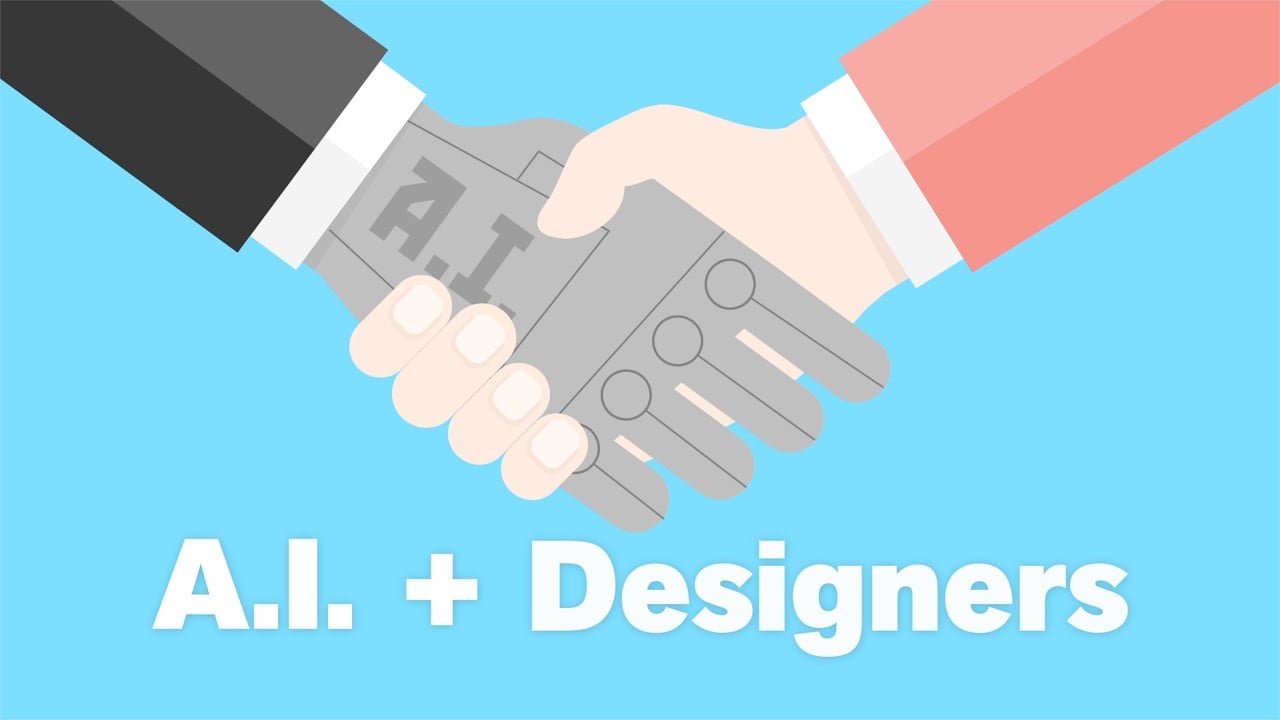
The technology for AI-based applications is truly advancing at an incredible pace.
Without a shadow of a doubt, artificial intelligence is the next-level disruptive technology that will entirely change the world as we know it.Seriously. The emergence of the AI era will parallel the significant technological advancements of the industrial era, transforming production and impacting nearly every industry in some way. And with AI image generators like readily available Stable Diffusion,Midjourney, and DALL-E 2, this reality is already becoming apparent in art and design.
We’re just now beginning to see legitimate use cases for AI in production, like Netflix using AI art for backgrounds, modified afterward by humans to create a 3-minute animation below. And it’s not just generative image AI. The popularity of ChatGPT on the rise has led to questions like will AI would replace copywriters. We’re even starting to see video generation AI models like Runway or Kaiber being used to create complete videos or heavily used during production, like in the music video for Linkin Park’s new song "Lost.”.
Generative AI has sparked existential anxiety over machine-driven job losses. Netflix's Dog and Boy short video, which uses AI picture synthesis to create its background artwork, reignited that worry.
The three-minute animated short by Ryotaro Makihara follows a youngster and his robotic dog through happy moments until taking a drastic turn into the post-apocalyptic. The end credits sequence credits "AI (+Human)" for beautiful backgrounds made by man and machine.

While these changes can be exciting because of their great potential uses, they can also be very concerning, especially for those unsure of how they will affect their job and way of life.
This is understandable because no one truly knows yet how much the full extent of AI will change the world around us. After all, AI is still in its infancy. In the overall context, the technology is still relatively new. And the potential for its applications is seemingly endless. But will it go far enough to invalidate professionals, creatives, and artists in graphic design jobs?
Let’s talk about it.
Table of Contents
How does generative AI work?
In case you aren’t sure how it works, we’ll recap quickly. Basically, generative AI design works via inputting a text in a prompt, much like you'd do in a Google search. You'd then enter a request, such as “Capybara with a cowboy hat,” hit enter, and let it run. The AI then generates a few images based on what it thinks you’re looking for.

The AI achieves this seemingly miraculous feat by consuming an enormous volume of data. We’re talking billions of images—photos, 3D models, paintings, drawings of all types, styles, and more. The AI then studies and trains with that data on how to create new, original outputs. Other AI models can take an image you drew and complete it based on the prompt you input alongside it. This type of AI, referred to as Img2img, or image-to-image, is an artificial intelligence system that utilizes an uploaded image as a foundation to produce a new, modified, or remixed image.
AI graphic design will change the playing field. That’s a fact. But will it take over the industry?
Change can be uncomfortable. As humans, we’re creatures of habit. It’s difficult to adjust, especially if it drastically changes how you’ve been doing things for so long. As such, many artists and graphic designers may see AI as a threat to their livelihoods. Just like during the Industrial Revolution, workers in agriculture and textiles were put out of work because it is physically impossible for people to match the efficiency of a machine.
Similarly, with AI’s ability to generate more images in mere minutes than a human could in months or in some cases, even years, it’s pretty normal to feel intimidated. It may even seem like the concept of creativity itself is under attack or that the very principle of expression and art is being undermined. And it’s valid to feel that way.
But artists and people of the digital era have been using new tools and shortcuts to optimize their processes and speed up their workflow for quite some time now. Take a digital painting, for example. Painting on a tablet PC instead of oil on canvas is inarguably a much faster and more efficient process, with conveniences that are impossible to have in the physical medium (such as the ever-important “Undo” button). However, this does not discredit the experience and skill required to execute a digital painting. It’s just a different way of creating.
Take this into consideration: have people stopped appreciating fine art as a result of digital art? Have art museums stopped showcasing the impressive contemporary works of fine artists? Has the Mona Lisa become any less iconic and stopped having about 10 million visitors annually? No—and barring a catastrophic end of the world, it’s unlikely that will change.
Granted, sure. While AI presents unique challenges and requires a distinct set of rules and ethics, the underlying principle remains unchanged. So to answer the question of “Will AI replace designers?”, I firmly believe that the answer is no.
And here’s why. While AI can replicate some aspects of a designer's job, it cannot fully replace the creativity and strategic oversight required in the field.
Why is AI unable to replace the role of the designer?
I believe enough time has passed to show the fundamental limitations of AI design, and because of that, I’m not convinced it can ever fully replace the designer's role.
Because, well, think about it. What is a graphic designer, and what are their fundamental roles?

Of course, as designers, we produce visually appealing collateral such as websites, logos, posters, and interfaces. But at the core of it all, what designers do for clients is solve problems. We establish branding strategies and create collateral that effectively communicates a business's offerings to its clients. We design materials so businesses can run better than ever before.
Fundamentally, designers are strategists who determine the best way to communicate ideas.
That is where our genuine value lies. The end result is crucial, but knowing how to execute it effectively is where we shine the most. That takes judgment, nuance, context, emotion, knowledge of personal and cultural history, and shared life experiences, among many other components of life that a machine cannot relate to.
These qualities will become more valuable than ever before because it’s something AI can’t replace. And that’s why AI won’t replace creative professionals.

The Human Element
Perhaps the most critically lacking part of AI at the moment is its lack of ability to empathize and understand humans and their problems in the way we can.
Artificial intelligence doesn’t live in the real world. It doesn’t understand what it means to feel vulnerable, to experience both the wonderful and horrible parts of life, to have opinions and beliefs, or to create emotional connections.
And these things are impossible for an AI model to be perfectly trained on because there are just so many nuances in communication that depends on context, culture, timing, tone, body language, life experiences… so on and so forth. These things just can't be computed yet. AI doesn't understand or consider those factors when generating its visual outputs. All it can read is a prompt.
And while it's capable of some very impressive outputs, AI developing those qualities is still very much within the realm of science fiction.
Originality And AI Fatique
Creativity will not be able to be replaced by an AI. This is because an AI can only create based on what it has been trained on. It will always lag behind anything cutting-edge because it will take time for the models to gather enough data to replicate it flawlessly and reliably.
The future of originality is, well, future-proofed in that sense.
On the flip side, this will also lead to an overabundance of established visual trends by creators who are less proficient in generating new ideas. In fact, we’re already seeing this. Many of the current examples of popular AI art all follow similar styles and have a similar vibe to them.

When many companies start using this frequently, it will very quickly begin to lose its edge. The more it’s overused, the easier it will be for it to blend into the crowd. And with how easy it is to create AI images, you can expect that crowd to be absolutely enormous.
How can I be so sure? Well… because it’s happened before. Knock knock, remember stock photography and graphics? How often have you seen a generic stock image of people in business suits shaking hands?

Even though this image is well lit, composed, in focus — all around top-notch from a technical point of view… it’s pretty boring. Why? Because even though you may not have seen this specific photo, you’ve already seen so many others that are basically the same thing.
Work heavily relying on stock photography or graphics nowadays is usually overlooked for that reason. And this will fundamentally be no different with AI options entering the equation.
Legality
I’m not a legal expert, but the current state of the legality of AI art tools is a bit of an unknown entity, to say the least. Amidst class action lawsuits being taken against a few generative image models and people using AI versions of Drake and The Weeknd's voices to create a song under their name... well, let's just say there might be a bumpy legal road ahead for AI.
The US Copyright Office has declared anything generated by AI using a text input will not be protected by copyright laws. This is because the USCO only recognizes work authored by humans. Since machines and AI are not human, they cannot be classified as authors, and what they output is thus not copyrightable.
But what does that mean for the world of design?
- Nothing legally stops anyone from co-opting AI-generated outputs for their use, for profit, or for branding efforts. It's the same as using stock photography.
- As such, AI outputs may be used by bad actors, companies, or anyone else who may misrepresent the original intentions of the image — and there is no currently established protection against this from happening. Do you want your images to be associated with an entity creating questionable content?
- Even if human work was performed on the output afterward, the USCO would only deem it copyrightable on a case-by-case basis. This means that only the final result may be copyrightable only if sufficient evidence is provided. And with AI tools becoming more and more accessible, I would wager that getting that copyright approval would take forever. There is also the possibility that only the work performed afterward by a human is copyrightable. The initial output, however, would still be unprotected.
Ethics
There is also the question of ethics. Popular AI models like Midjourney or Stable Diffusion have been trained upon billions of copyrighted works across the internet that have never given explicit permission, consent, or compensation to be used as training material.
Whether or not you agree with whether that constitutes fair use, it's clear to see that there are very reasonable ethical concerns.
On the other hand, there are also companies attempting to create a generative AI responsibly, such as Adobe with their Firefly AI product, who emphasize only training their AI on images from creators who have consented, among other efforts for as much transparency with AI as possible. We are looking forward to seeing this tool grow. Adobe is the OG when it comes to graphic design tools.
Regardless of how it ends up, there is no doubt a long legal journey ahead for the implementation of AI in design. Designers and agencies who create their own original works, or understand how to navigate the new AI landscape, will save companies this potential headache.

How will AI help designers?
While AI was never really meant to be a replacement, it can and will be a very powerful way of augmenting creative professionals' workflows to be faster and better than ever before.
But just like knowing how to use auto-tune doesn’t make you a good singer, knowing how to use AI tools won’t make you a good designer. However, being a good designer who knows how to incorporate AI into their workflow will turn them into true powerhouses.
Remember, the tools are only as good as the person using them. The best camera in the world won’t make the worst photographer shoot any better.
Let’s take a look at the ways AI tools will change the game for those willing to incorporate it into their workflow.
Production time will become faster than ever
The sole purpose of AI tools is to make things simpler and faster than ever before. This will be evident in the workplace, as projects will be able to advance at a much faster rate.
For instance, even the most skilled designers and Photoshop professionals could dedicate numerous hours to perfecting a photorealistic effect, which previously necessitated high-resolution images with appropriate lighting and a precise viewpoint.
AI technology will completely transform this. Instead, we'll be able to merge or create totally new images almost immediately. We will be able to provide an idea and an image, and the AI will fill in the gaps.
This will be a huge timesaver!

Designers will have to adjust to this quickly. The proliferation of tools requires designers to constantly stay up-to-date with the latest technology to optimize efficiency.
As a result of this, I think we’ll be seeing AI help us get projects done faster. Some companies will use this as a way to budget more effectively, cut costs as needed, and shorten overall timelines — while other companies will see this boon as a way to allot more time for designers to spend that newly found time refining their designs further to achieve results that their budget would have usually restrained.
The ability to iterate will be on another level
During the design process, the bulk of the time is spent exploring options. For example, designing logos usually involves in-depth exploration of tens and sometimes hundreds of sketches and ideas before establishing a solid direction. Unless you’re Paula Scher and can create the perfect approach to a 1.5 million dollar logo on a quick napkin drawing during a 5-minute meeting, it’s extremely unlikely for a design project to find the perfect approach on the first sketch.

With AI, that process might change entirely. With IMG2IMG AI technology, we may see a handful of sketches with a prompt generating hundreds of options at a time. Or new ideas being explored much more quickly by making rapid prototyping adjustments on the fly. This will make designers more powerful and productive than ever.
We’ll be able to explore options much faster than before, which means way more chances for that “Aha!”, “Eureka!”, or “That’s it!” moments happening earlier during the process.
AI can handle the grunt work
As with most professions — there are always less exciting parts of the job, but still equally important to the process. And design is, of course, no different. Fortunately, we may see AI taking over some of the less savory tasks that often get delegated to junior designers (those who have paid their dues will know what I’m talking about).
For example, cropping or resizing images, color correction, setting up project files, mockups, and so on and so forth. Especially so when there are 10s or even 100s of files to go through for larger projects.
Having an AI handle those less technically demanding, albeit time-consuming and equally important tasks, would free up a lot amount of time for designers and allow them to focus on the tasks that AI can’t yet handle — like strategic creative decisions, or fine-tuning the visuals and polishing the details as much as possible.
How Graphic Designers Can Thrive in an AI-Assisted Industry
To thrive in an AI-assisted industry, graphic designers must learn to work alongside AI tools, leveraging their strengths to augment their own creative abilities. This means embracing AI as a collaborative tool, rather than a replacement for human designers. By doing so, designers can unlock new levels of efficiency and creativity, allowing them to focus on what they do best: creating stunning visuals that communicate powerful messages.
Embracing AI as a Collaborative Design Tool
AI-powered tools can automate repetitive tasks, freeing up graphic designers to focus on high-level creative work. By embracing AI as a collaborative tool, designers can:
- Use AI to generate initial design concepts, which can then be refined and perfected by human designers. This allows for a more efficient design process, where the initial groundwork is laid by AI, and the final touches are added by human creativity.
- Leverage AI-powered tools to analyze data and provide insights that inform design decisions. For example, AI can analyze user behavior and preferences, helping designers create more targeted and effective designs.
- Utilize AI to automate tasks such as formatting and layout, allowing designers to focus on more creative aspects of the design process. This can significantly reduce the time spent on mundane tasks, giving designers more time to experiment and innovate.

Developing Unique Skills Beyond AI’s Reach
While AI can perform certain tasks with ease, there are many aspects of graphic design that require human creativity, empathy, and problem-solving skills. To remain relevant in an AI-assisted industry, graphic designers must develop unique skills that go beyond AI’s capabilities, such as:
- Developing a deep understanding of human psychology and behavior to create designs that resonate with target audiences. This involves understanding what motivates people, what captures their attention, and what drives their actions.
- Cultivating strong communication and collaboration skills to work effectively with clients and stakeholders. This includes the ability to listen, interpret feedback, and articulate design concepts clearly and persuasively.
- Staying up-to-date with the latest design trends and technologies to remain competitive in the industry. This means continuously learning and adapting to new tools, techniques, and best practices, ensuring that your skills remain sharp and relevant.
Continuous Learning and Adaptation
The graphic design industry is constantly evolving, and AI is just one of the many technologies that are changing the landscape. To thrive in this environment, graphic designers must be committed to continuous learning and adaptation, staying up-to-date with the latest AI tools and technologies, as well as emerging trends and best practices.
By embracing AI as a collaborative tool, developing unique skills beyond AI’s reach, and committing to continuous learning and adaptation, graphic designers can not only survive but thrive in an AI-assisted industry. The key is to view AI not as a threat, but as an ally that can help you unlock new levels of creativity and efficiency, allowing you to create more impactful and resonant designs.

The future of design — and how not to get left behind
Until now, designers have had to strike a balance between refining their creativity and becoming technically proficient in design software to execute the best design possible. With AI greatly helping designers on the technical proficiency side of things, refining your creativity will become more valuable than ever. Out-of-the-box thinking, imagination, and your overall ability to conjure the vision for your visual strategies.
Going forward, I would recommend playing to those strengths and also refining your "soft skills"—communication, interpersonal skills, adaptability, problem-solving, and so on—which will be crucial.
Learn how to ask better questions to truly understand the client’s needs. The human element will be more important than ever because that will ultimately separate the good designers from the bad and the ugly.
Those that begin learning and adjusting to advances in AI design will be on the greatest course to success.
But be cautious. Designers that rely too heavily on AI, either by overusing it or becoming lazy with their job, are likely due for a nasty awakening. Falling into that trap is a sure formula for blending in and becoming just another face in the crowd of individuals left in the dust or attempting to exploit AI to make a fast profit.
The human element has always been crucial. However, as we continue to advance into the exciting realm of AI, the importance of human interaction will become increasingly evident, as individuals have a deep-seated desire for authentic experiences. Real work. Real stories. Real connections. And if you need a creative design agency that knows how to do "Real" really well and can help your business navigate the new digital landscape of AI, Mighty Fine will have you covered, and then some.
